Mittwoch, 8. Mai 2013
Ermüdungserscheinungen / keine Lust mehr / neue Taktik oder einfach nur ein Versehen nach über 10 Jahren Streitkultur Anleihegläubiger vs Argentinien....Weitere Ausführungen sind nicht veranlasst, denn die Beklagte hat innerhalb der ihr eingeräumten Frist keine Stellungnahme abgegeben...
Ermüdungserscheinungen / keine Lust mehr / neue Taktik oder einfach nur ein Versehen nach über 10 Jahren Streitkultur Anleihegläubiger vs Argentinien....Weitere Ausführungen sind nicht veranlasst, denn die Beklagte hat innerhalb der ihr eingeräumten Frist keine Stellungnahme abgegeben...
OBERLANDESGERICHT FRANKFURT AM MAIN
BESCHLUSS
ln dem Rechtsstreit
Republik Argentinien, vertreten durch die Procuracion del Tesoro de la Naciön,
Posadas 1641, Piso 1, 1112 Ciudad Autonöma de Buenos Aires, Argentinien,
Beklagte und Berufungsklägerin,
Prozessbevollmächtigte:
Rechtsanwälte Wolfgang Strba & Kollegen, Eschenheimer Anlage 28,
60318 Frankfurt am Main,
gegen
n Koch, Zur Eisernen Hand 25, 64367 Mühltal,
Kläger und Berufungsbeklagter,
2
Prozessbevollmächtigte:
Rechtsanwälte nn
hat der 8. Zivilsenat des Oberlandesgerichts Frankfurt am Main durch die
Vorsitzende Richterin am Oberlandesgericht Kagerer, Richterin am
Oberlandesgericht Bogner und Richter am Oberlandesgericht Tillmanns am
25.4.2013 einstimmig beschlossen:
Die Berufung der Beklagten gegen das am 5.7.2012 verkündete Urteil der 19.
Zivilkammer des Landgerichts Frankfurt/Main wird zurückgewiesen.
Die Beklagte hat die Kosten des Berufungsverfahrens zu tragen.
Das angefochtene Urteil ist ohne Sicherheitsleistung vorläufig vollstreckbar.
Die Beklagte darf die Vollstreckung durch Sicherheitsleistung in Höhe von
110% des auf Grund des Urteils vollstreckbaren Betrages abwenden, wenn
nicht der Kläger vor der Vollstreckung Sicherheit in Höhe von 110% des
jeweils zu vollstreckenden Betrages leistet.
Der Streitwert der Berufung wird auf 145.206,89 € festgesetzt.
Gründe:
I.
Die Berufung war nach § 522 Abs. 2 Satz 1 ZPO zurückzuweisen. Sie hat keine
Aussicht auf Erfolg. Die Rechtssache hat keine grundsätzliche Bedeutung. Die
Fortbildung des Rechts oder die Sicherung einer einheitlichen Rechtsprechung
erfordern eine Entscheidung des Berufungsgerichts nicht. Eine mündliche
Verhandlung ist nicht geboten. Die Sach- und Rechtslage konnte mit der Beklagten
im schriftlichen Verfahren angemessen erörtert werden.
3
1. Zur Darstellung des Sach- und Streitstandes nebst Änderungen und Ergänzungen
wird auf den Hinweisbeschluss des Senats vom 21.3.2013 sowie auf die
tatsächlichen Feststellungen in dem angefochtenen Urteil Bezug genommen.
2. Das Rechtsmittel ist unbegründet, was der Senat in seinem Hinweisbeschluss vom
21.3.2013 bereits ausgeführt hat. Hierauf wird verwiesen. Weitere Ausführungen sind
nicht veranlasst, denn die Beklagte hat innerhalb der ihr eingeräumten Frist keine
Stellungnahme abgegeben.
3. Die Kostenentscheidung folgt aus § 97 Abs. 1 ZPO. Die Entscheidung über die
vorläufige Vollstreckbarkeit hat ihre Grundlage in den §§ 708 Ziffer 10, 711 ZPO.
Der Streitwert entspricht dem Nennwert der der Klageforderung zugrunde liegenden
Inhaber - Teilschuldverschreibungen.
nn
Vorsitzende Richterin am
Oberlandesgericht
nn nn
Richter am Oberlandesgericht Richterin am Oberlandesgericht


Dienstag, 7. Mai 2013
Argentina’s Impsa Postpones Dollar Bond Sale as Investors Balk
Argentina’s Impsa Postpones Dollar Bond Sale as Investors Balk
By Camila Russo & Veronica Navarro Espinosa - May 6, 2013 8:26 PM GMT+0200
Argentine wind-farm operator Industrias Metalurgicas Pescarmona SA postponed a dollar bond sale as investors demanded higher yields than the company was willing to pay.
Impsa, as the Mendoza, Argentina-based company is known, had been planning to sell five-year notes overseas to yield about 11 percent, Carla Paira, a press official, said in an e- mailed response to questions. Existing bonds due in 2020 tumbled, pushing yields up 1.08 percentage points to a four- month high of 13.35 percent at 1:30 p.m. New York time, according to data compiled by Bloomberg.
“There was lack of agreement between the company and the investors over the pricing,” Paira wrote. “Impsa will keep monitoring the market in search of new opportunities.”
The company had hired Barclays Plc, Banco Bradesco SA and UBS AG to arrange meetings with investors from April 29 to May 1, according to a person familiar with the discussions who asked not to be identified because the meetings were to be private. Argentine companies haven’t borrowed in overseas debt markets since May 2012.
To contact the reporters on this story: Camila Russo in Buenos Aires atcrusso15@bloomberg.net; Veronica Navarro Espinosa in New York atvespinosa@bloomberg.net
To contact the editor responsible for this story: David Papadopoulos atpapadopoulos@bloomberg.net
Vulture fund says that Argentina spent US$250 million on lawyers
El Cronista
Vulture fund says that Argentina spent US$250 million on lawyers
Monday, May 06, 2013
By Laura Garcia
After everything, Argentina’s arch-enemy, Paul Singer, is also human. And not only resistant to being called a vulture. He also seems a little tired of a legal battle as arduous as it is onerous.
Thus at least he let it be known in his latest letter to investors from the multimillionaire that is at the head of the lawsuit against Argentina over the debt in default.
“It’s a little known fact that Elliott began buying Argentine debt before the default of 2001,” says the head of a fund that manages almost US$22 billion and today is suing the country for payment of some US$1.3 billion.
According to Argentina, however, the bonds involved in the case had been acquired in 2008 for only US$48.7 billion.
Of course, a decade of litigation isn’t just for anyone. And Singer lets off steam: “To litigate is expensive and few have the means, the tools or the stomach to put up with an excessively long legal battle with an intractable adversary, if not irrational.”
And he even risks an estimate for the controversy, saying that Argentina has already spent approximately US$250 million on legal bills related to more than 20 lawsuits.
Could one conjecture that this same Singer being highly focused on the costs of a battle is an indicator of the certain readiness of mood to negotiate?
With difficult. But it’s clear that it contrasts with the combative Singer of last November, who said sarcastically that he hadn’t bought Argentine debt to end up with “a boat too large to sail off Long Island,” an allusion, clearly, to the attachment of the Frigate Libertad.
Meanwhile, the market awaits the decision of the Court of Appeals with attention paid to the central issue of the intermediaries and the possibility that the court would intercept any payment destined to the exchange bondholders to guarantee payment to the vulture funds. Beyond the clear recovery of bonds mounted upon the expectation of a gadget which allows the eluding of a negative ruling, few believe there will be some favorable surprise. “We are convinced that the scenario of a negotiated solution is unlikely during the Kirchner administration and we are concerned about a re-routing of payments being difficult to implement from the point of view of the mechanics,” said Vladimir Werning of JPMorgan in his report last week.
In any case, it isn’t only Argentina that Singer rants about.
He doubts that the Cypriot crisis will be an isolated case as Europe is striving to emphasize, saying that the bureaucrats of the Fed could carry the United States to another depression with their policy of indiscriminate emission and he complains about the fall of gold prices. But nobody angers him like Argentina.
Montag, 6. Mai 2013
Die Top-5 Fonds im Detail
Die Top-5 Fonds im Detail
ISIN Fondsname
LU0180621863 Aviva Investors Emerging Markets Bond B
LU0128467544 Pictet-Global Emerging Debt-P USD
LU0099919721 HSBC GIF Global Emerging Markets Bond PD USD
LU0168601234 F&C Emerging Markets Bond A
LU0125948108 MFS Meridian Funds Emerging Markets Debt A1 USD
Unten angeführte Tabelle beinhaltet weitere Kennzahlen (u.a. Information-Ratio) und Detailinformationen zu den Top-5 globalen Emerging Markets Anleihenfonds (gemessen nach 5-Jahres Sharpe-Ratio). Bitte beachten Sie die teilweise unterschiedlichen Vertriebszulassungen.

Freitag, 3. Mai 2013
Falkland Island’s: Argentina reclaims “absolute and exclusive sovereignty over the Islands”
Thursday, May 2nd 2013 - 06:12 UTC


Falkland Island’s: Argentina reclaims “absolute and exclusive sovereignty over the Islands”
Defence minister Arturo Puricelli said that Argentines “are not prepared to tolerate the usurpation” of the Malvinas Islands ‘for the rest of our lives’ and the honour and glory for those who fought in the South Atlantic “is going to be recalled until we obtain absolute and exclusive sovereignty over our Islands”.


“For us Malvinas is a cause that will never prescribe in the life of the nation and will only end the day the Argentine flag is flying over the Malvinas and South Atlantic Islands” added Puricelli during a military ceremony to commemorate the 31st anniversary of the Argentine Air Force ‘baptism of fire’ on May first 1982 during the Falklands conflict.
The ceremony at the El Palomar Air Force base was also attended by the Argentine Armed Forces Chief of Staff, Jorge Chevallier, the head of the Air Force, Normando Constantino, other government and provincial officials, lawmakers, local magistrates, members of the three forces and Malvinas Veterans and Next of kin.
“We feel in this cause supported and accompanied the peoples and governments of the South American countries and so many others in the rest of the world”, added the minister.
Puricelli said that it is of special concern to the Argentine government “the design of a military instrument which fully guarantees the national defence all along our jurisdiction in the sea, the air and the ground”.
“Our commitment is to continue training men and women so that they belong to the Armed Forces of our nation with the same interest, courage and heroism displayed by the men, women, military and civilians during the South Atlantic war without asking for explanations, only dedicated to honour the allegiance to the flag”.
The minister during his speech transmitted “the greetings and acknowledgement of President Cristina Fernandez to the relatives of those combatants who lost their lives in the war and to the veterans who with the same courage and commitment were able to survive those heroic days”.
During the South Atlantic conflict the Argentine Air Force lost 55 personnel and almost of its combat wings. According to the Argentine version of events on May first after the British bombarded Falklands’ air strips, they were ready to land in the Islands but the Argentine Air Force reaction was immediate.
That May first started the “Air Battle of the Malvinas” and the Argentine combat aircraft at the end of the day had completed 57 attack and cover sorties against British naval targets dropping 20 tons of bombs.
Wednesday’s ceremony in El Palomar following the speeches ended with a military parade and an over-flight of Hercules C-130 and Bell-212 helicopters.
Mittwoch, 1. Mai 2013
If you tolerate this, more holdout lawsuits will be next
Well, this was fun while it lasted. Now what did it mean?
Click to enlarge the document capping a weird week in the pari passu saga:
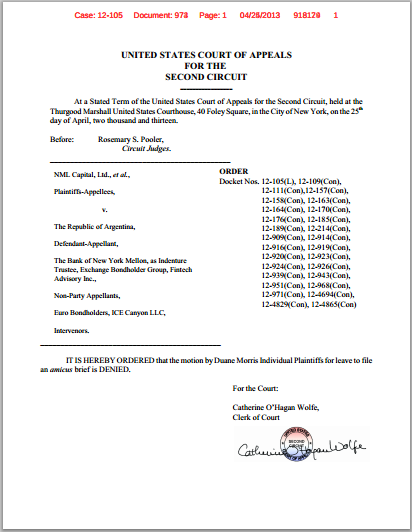
It’s an order from the Second Circuit on Thursday, denying an unusual request filed on Monday by the Italian retail investors who count themselves among Argentina’s holdouts.
Although looking back at it, was the unusual or just ahead of the curve?
These “Duane Morris” bondholders aren’t among the actual plaintiffs in the pari passu saga. Individuals in this group have already sought judgments on defaulted Argentine debt in other cases. (NML wants injunctive relief, remember.) Taken as a group, the Italian bondholders aren’t known for using US courts as their main forum: that would be ICSID, the World Bank’s investment arbitration tribunal. Indeed there was a time, not so long ago, when the Abaclat case looked like it might rival Elliott’s litigation for finally getting Argentina to cough up. Until Elliott’s pari passu spadework started paying off.
Anyway, Duane Morris still sought to give their two cents on Argentina’s court-ordered proposal for repaying the (past-due) holdout bonds “at issue in this litigation”.
Two cents, in order to get a lot more than 100 cents back on the dollar, it seems:
Retroactively, the only sensible resolution is a lump-sum payment of all interest and principal that has accrued and become due and payable in eleven years to all the current holders of the holdout bonds…
Emphasis in original. And that is where this week’s troubles began.
You can read what happened next in Anna Gelpern’s excellent series of posts hereand here. This particular post of Anna’s — appearing before the Duane Morris holders filed the amicus request — already got to the heart of it. And it is worth expanding upon.
Tom, Dick, and Dirty Harry
It’s the first time in the actual legal briefs of this saga that a fairly straight line has been drawn between the idea of ratable payment on sovereign bonds, and the idea of bondholders suing each other over sharing out the receipt of those payments.
Essentially, creditor A should be allowed to sue creditor B for her share of the pie, if the sovereign’s ratable payment goes only to creditor B and not A.
This is the Tom, Dick, and Harry problem. Generally, it’s been seen either as the path to the Dark Side of the Force and/or endless litigation (not just over Argentina), or as the logical view of the kind of pari passu clause which Argentina’s defaulted bonds possess.
Technically, the problem has come up in the saga before, as the theory that NML and other plaintiffs could sue the restructured holders, if the latter took part in a swap of their debt to help Argentina avoid the injunction. But that wasn’t such a straight line. (For a start, the suits might apply to the likes of Bank of New York first. And this is all theory.)
Anyway — arguably, when it came to this week’s pari passu playground politics, NML started it.
Of course, NML came down like a ton of bricks on the Duane Morris filing. This was amusing in that the Duane Morris filing is, on the substance, more or less a carbon copy of what NML had argued about Argentina’s proposal. Same indignation (perhapsless florid), same arguments (more or less cogent) that the plan fillets the original bonds of past due interest through valuation trickery.
So, NML’s beef was procedural:
We note that the Duane Morris Individual Bondholders refer to themselves as “plaintiffs.” They are not plaintiffs in this action… this Court’s March 1 Order directed Argentina to state what it is prepared to pay Appellees specifically, not what it is willing to pay adversaries in other cases… granting the Duane Morris Individual Bondholders’ motion would surely draw a forest’s worth of proposed amicus filings… opens the door to a fusillade of unnecessary and inappropriate briefing…
This is not mere plaintiff snobbery — the argument was that Argentina would benefit from further delays. (The court’s quick dismissal of the Duane Morris request helps there.)
Still. NML didn’t talk about this part of their own response to Argentina:
Accordingly, the only amount Argentina would pay as a result of this Court affirming the district court’s Injunction is $1.47 billion, which is a mere fraction of what Argentina paid to the Exchange Bondholders in December 2012 alone. If holders of other defaulted indebtedness later bring equal treatment claims of their own, Argentina will have ample opportunity both to litigate the merits (taking into account any factors that may distinguish those bonds from the ones at issue here, including different contractual language and governing law) and to make a showing of financial need, based on circumstances then prevailing, for the district court to consider in shaping a remedy.
Emphasis ours. This was new — and interesting, especially if “other defaulted indebtedness” includes the same “FAA” bonds held by NML and the plaintiffs, and therefore the same pari passu language. Which is what the Duane Morris non-plaintiffs hold.
Holdouts versus holdouts
In that case, contrast the suggestion that these bondholders rely on Argentina’s future “showing of financial need” with their sudden call for the full repayment of “allthe current holders of the holdout bonds”.
That would inflate NML’s “only $1.47bn” to something closer to perhaps $15bn of pari passu claims also knocking on the Republic’s door. This is the pari passu saga, not the plunging peso saga, but when it comes to “circumstances then prevailing”, it’s firstlynot hard to miss what’s been happening to central bank reserves.
Secondly, it’s possibly a danger to the actual plaintiffs. Although NML is only talking about other holders one day suing Argentina, and the Duane Morris proposed amicus brief is aimed at Argentina, the people to sue over the less than full payment of the $15bn or so are perhaps no longer just Argentina.
The other main parties in this case also wanted the court to throw the Duane Morris amicus brief out — some for procedural reasons a bit like NML’s (the Exchange Bondholder Group). Others, however, lost no time linking it back to NML’s case.
This was Fintech for instance:
Appellees urge this Court to confirm a remedy which will make them whole, but leave the other Original Bondholders (including Fintech) holding the same exact rights at the whim of the future ability of the Republic to pay…
Which then quickly turned into a warning to the courts that they would soon be litigating holdouts versus holdouts:
To the extent Appellees’ position on appeal is correct, each of the Original Bondholders that stand in Appellees’ shoes and would be entitled to assert the same arguments and to obtain the same relief…Chaos would ensue as Original Bondholders around the world stake competing claims on the Republic’s limited resources. Moreover, other Original Bondholders could seek – and likely obtain – injunctive relief(possibly on a class-wide basis) to preclude Appellees and other Original Bondholders from obtaining recovery before the parties seeking an injunction are able to do so.
This is perhaps why the court’s denial of the Duane Morris request just to file as amici isn’t the end of this story.
The Duane Morris holders aren’t even the first judgment creditors of the FAA bonds to imply that they could be looking at bringing pari passu claims after an NML victory: that would be EM Ltd. (It “believes that the Equal Treatment Provision applies with identical force in the post-judgment context…”)
Fintech also suggest a vehicle for these holders to do that on the back of a ratable payment to the plaintiffs in this case — something called mandatory class actions, an idea considered for sovereign debt workouts by Buchheit and Gulati in 2002, and which would get the courts to review full payment to one creditor if it might “substantially impair or impede” other creditors getting theirs. It comes from the slightly decrepit hinterland of bankruptcy law.
Which is of course the point.
The US courts in the pari passu saga initially swore off anything like sovereign bankruptcy for Argentina, having ruled on the actual case as a “simple question of contract interpretation.” (Ever since then we’ve only been talking remedies.) The Second Circuit seemed to move away from that a bit nevertheless, when it came to Argentina ordering the Republic’s alternative idea for repaying holdouts rather than throwing the book at it straight away.
Even so, the court’s final ruling (when it comes) surely won’t be paying Argentina’s idea much shrift there.
But holdouts vs holdouts really can be a thing under the expected final ruling – assuming the Duane Morris amicus episode isn’t the end of it – then isn’t a bastardised version of sovereign bankruptcy coming our way in any case?
Abonnieren
Posts (Atom)