Gesamtzahl der Seitenaufrufe

Freitag, 24. Mai 2013

Pari passu’s peso problem?


Pari passu’s peso problem?

Hat-tip to Bloomberg — it looks like we have a new entrant in the pari passu saga.
Citibank.
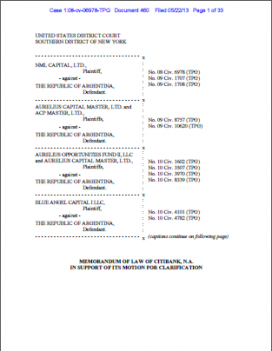
Technically it’s Citibank’s Argentine branch. They’ve made a slightly curious requestfor ‘clarification’ of Judge Griesa’s order last November for Argentina to pay bond holdouts alongside other, restructured creditors. (Payments just to the latter could be seized, and ultimately launch Argentina into a sovereign default… just to catch you up.)
Curious, because Citi seems to think any seizure could jump a certain — critical — bond-market species barrier.
So far in the saga, those ‘other, restructured creditors’ have mostly been holders of bonds which came out of Argentina’s debt swaps as governed under New York law. They also get paid out (in US dollars) using a New York-law trustee. A fight’s also brewing over whether Argentina’s payments on English-law versions of the debt, owned by the so-called Euro Bondholders, could be seized. Still, these are international creditors of Argentina.
The Republic can’t easily borrow fresh international debt these days anyway, precisely because the holdouts are ready to litigate. But the local-law market for Argentine debt is… thriving’s maybe not quite the word, but it’s there.
And it’s what Citibank has a finger in, through custody accounts at the Argentine branch — Argentine-law, US dollar and Argentine peso-denominated bonds which came out of the restructuring. Apparently the way Citi tells it, there’s no part of the payment system for these bonds that lives in New York either.
Why then is Citibank so keen to point out the following to Judge Thomas Griesa?:
No participant in the litigation leading to the issuance of the November 21 Orders addressed the Argentine Law Bonds, and there is nothing in the Court’s opinion or the terms of the November 21 Orders to suggest that the Argentine Law Bonds were within the contemplation of the parties or the Court…
Indeed, while the unprecedented interpretation given by this Court and the Second Circuit to the pari passu provision in the defaulted bonds has been a matter of dispute, there is no dispute that the second clause of the provision excludes on its face the Peso-denominated Argentine Law Bonds from its reach: “The payment obligation of the Republic under the Securities shall at all times rank at least equally with all its other present and future unsecured and unsubordinated External Indebtedness.” The Peso-denominated Bonds do not constitute “External Indebtedness” within the meaning of this clause…
As a general principle, the Argentine legal system does not recognize as enforceable the acts of foreign courts… Therefore, were Citibank Argentina to act in violation of Argentine law, the November 21 Orders would provide no shield.
Because it’s been here before between Argentina and its holdouts.
As Citibank also reminds Judge Griesa, he threw out an attempt by EM Ltd to seize funds handled by the bank paying Argentina’s Boden 2012 debt, a US dollar local-law bond which it originally issued to depositors hit by the corralito. Argentina “lost control” of the payments it made on the Boden somewhere in Argentina and they were no longer its assets thereafter, so the holdouts couldn’t seize them, Griesa said.
That Citibank is trying to make these points clear all over again about the pari passu ‘remedy’ shows how powerful (feared?) the clause has become.
It also suggests the order could be read as applying to local-law bonds somehow — because why else would Citibank bother the court for clarification.
Also, let’s assume Griesa will pay attention to Citibank, agree with them and rule out payment systems for local-law debt from the scope of this order. You’re Argentina. You possibly plan to nullify the order’s effect anyway — a favourite theme of the holdouts, this, though there’s no hard evidence a plan is motion here — precisely by offering foreign-law restructured holders their choice of equivalent local-law securities, to be paid nowhere near New York.
We still think it would be highly quixotic; it’s been made supremely difficult toorganise any swap under the terms of the order. A key part of it has not been stayed when it comes to banning both the Argentine government from making this kind of plan, and any lawyers or other agents that could aid and abet it. Still, what effect — if any — would a clarification in Citibank’s favour have here?
One to ponder.

Citibank Argues Bond Rulings Don’t Apply to Argentina Branch


Bloomberg News

Citibank Argues Bond Rulings Don’t Apply to Argentina Branch

By Bob Van Voris and Patricia Hurtado
May 23, 2013
Citigroup Inc. (C), whose Citibank unit is the local custodian for some holders of Argentine bonds, asked a U.S. judge to make clear that it isn’t affected by his order barring payments to holders of restructured debt unless holders of defaulted bonds are also paid.
Citibank yesterday asked U.S. District Judge Thomas Griesa in Manhattan for a ruling clarifying earlier decisions in a case against Argentina led by Elliott Management Corp.’s NML Capital. Citibank, which said its Argentina branch is custodian for bonds issued under that country’s laws that are to be paid within Argentina, isn’t a party to the NML suit.
Griesa, who is overseeing litigation over Argentina’s defaulted debt, issued an order in November requiring the nation to pay NML and other holders of the defaulted bonds before paying investors who exchanged their bonds for new ones, at a sharp discount, in debt restructurings in 2005 and 2010.
Citibank said it is seeking clarification because Griesa’s rulings may expose it to “grave regulatory, civil and possible criminal risk for obeying a court order not recognized as valid in Argentina.”
The case is NML Capital Ltd. v. Republic of Argentina, 08-cv-06978, U.S. District Court, Southern District of New York (Manhattan).
To contact the reporters on this story: Bob Van Voris in New York at rvanvoris@bloomberg.net; Patricia Hurtado in New York at pathurtado@bloomberg.net
To contact the editor responsible for this story: Michael Hytha at mhytha@bloomberg.net

Dienstag, 21. Mai 2013

Am 7.6.2013 wird vor dem OLG Ffm um 11:30 eine Zeugeneinvernahme durchgeführt mit dem Hintergrund das ein Anwalt für seine Mutter Argentinien Stücke einklagt bei denen die Inhaberschaft (Eigentum ?) zweifelhaft ist


Am 7.6.2013 wird vor dem OLG Ffm um 11:30 eine Zeugeneinvernahme durchgeführt mit dem Hintergrund das ein Anwalt für seine Mutter Argentinien Stücke einklagt bei denen die Inhaberschaft (Eigentum ?) zweifelhaft ist


Am 7.6.2013 wird vor dem OLG Ffm um 11:30 eine Zeugeneinvernahme durchgeführt mit dem Hintergrund das ein Anwalt für seine Mutter Argentinien Stücke einklagt bei denen die Inhaberschaft (Eigentum ?) zweifelhaft ist


Am 7.6.2013 wird vor dem OLG Ffm um 11:30 eine Zeugeneinvernahme durchgeführt mit dem Hintergrund das ein Anwalt für seine Mutter Argentinien Stücke einklagt bei denen die Inhaberschaft (Eigentum ?) zweifelhaft ist

Am 7.6.2013 wird vor dem OLG Ffm um 11:30 eine Zeugeneinvernahme durchgeführt mit dem Hintergrund das ein Anwalt für seine Mutter Argentinien Stücke einklagt bei denen die Inhaberschaft (Eigentum ?) zweifelhaft ist. Zu prüfen wäre Prozessbetrug und andere strafbare Handlungen.

Wer näheres wissen will:

rolfjkoch@web.de

--------------------------------------

Der GF (der den Beruf eines Anwaltes ausübt) einer Klagegesellschaft geprellter Argentinienanleiheninhaber wurde von der Anwältin des (Mit)Gesellschafters und stillem Beteiligten der Klage vs Argentinien wegen des Verdachtes auf Untreue aus einem Betrag von knapp 100.000€ bei der Augsburger Staatsanwaltschaft angezeigt.

Der GF (der den Beruf eines Anwaltes ausübt) einer Klagegesellschaft geprellter Argentinienanleiheninhaber wurde von der Anwältin des (Mit)Gesellschafters und stillem Beteiligten der Klage vs Argentinien wegen des Verdachtes auf Untreue aus einem Betrag von knapp 100.000€ bei der Augsburger Staatsanwaltschaft angezeigt. Der Hintergrund ist eine unklare Entnahme des GF aus dem Gesellschaftsvermögen die in den Bilanzen mal als Gesellschafterdarlehen und auch anders bezeichnet wurde bzw. ausgewiesen wurde. Diese Bilanzen sind im e-Bundesanzeiger abrufbar.

näheres unter

rolfjkoch@web.de

“…The Argentine government jawboned the foreign exchange market more efficiently than Draghi did with the gold market upon the insinuation that Cyprus would sell its gold…”


Guest Post: Another Episode In The History Of Failed Manipulations

Tyler Durden's picture


Submitted by Martin Sibileau of A View from the Trenches blog,
“…The Argentine government jawboned the foreign exchange market more efficiently than Draghi did with the gold market upon the insinuation that Cyprus would sell its gold…”
I am back from a brief trip to Argentina’s Patagonia, where I could confirm first-hand the irreversible damage caused by interventionist policies: Widespread poverty, abandoned infrastructure, scarcity of consumer goods, unseen unemployment and criminality, etc. I could also see for myself the madness of hedging against inflation with the purchase of new cars. The streets of any forgotten small town in Patagonia are filled with brand new 4×4 vehicles that would be the envy of many in North America.
While visiting too, the Argentine government made a new move to suppress the price of the physical US dollar. In previous articles (here and here), I made the case that the broken US dollar market in Argentina would provide insights into what we may eventually expect from the gold market, if it broke in the same fashion. However, I had underestimated the magnitude of the USD physical market. Zerohedge brought attention to this point a few days ago (here).

Overview

In August of 2011, Argentina’s government slowly began to implement a series of actions destined to curtail the right of citizens to access US dollars (foreign exchange in general). The goal was and is to force savings into pesos, as pesos are after the taxable asset in a country that cannot access capital markets and fully monetizes its deficits.
From that moment onward  physical US dollars started to trade at a premium. Last week, with the paper US dollar value at 5.11 pesos, that premium was over 100%. Physical US dollars, i.e. dollars outside the system, reached a bid/ask of 10.30/10.45 pesos. The chart below should help visualize this dynamic (source: Reuters/La Nación)
May 20 2013 1

The latest move: Tax moratorium to repatriate capital

With a 100% premium over the “official” price of the US dollar, on May 7th, the federal government announced a moratorium for off-shore capital (see here, in Spanish). A simple reading of this measure would reveal a government encouraging capital inflows to an investments-starving nation. The moratorium, after all, is for capital directed to the real estate and energy sectors. The real intention behind it is, however, to narrow the gap between the official and black market price of the US dollar, via manipulation of the “official” price, as I will show further below. At the official price, of course, one finds no sellers.
The moratorium is a tax pardon, no questions asked, for all Argentines who decide to bring onshore their undeclared US dollars deposited offshore. Although it is not clear yet whether the declared funds can be freely disposed of, the government seeks that they be applied to the purchase 2016 4% bonds issued by the federal government or USD certificates, issued by the central bank. These USD denominated certificates (see image below, source: La Nacion) are to be used to clear transactions in the real estate sector, are fully endorsable and have no maturity. In other words, the government wants to further segment the US dollar market.
May 20 2013 2
I can’t help speculating that years into the future, one would see a developed country implementing a similar measure to repatriate undeclared gold.

How it works

The tax moratorium is a simple transaction. Let’s forget about the USD certificates issued by the central bank that pay no interest and assume that the public will accept them like US dollars. We are talking about a public that already holds 1 every 15 US dollar bills in the world. My view is that these will not prosper, because I doubt that anyone selling real estate would be willing to take them at face value.
We are left with the 4% coupon bonds issued by the federal government, maturing in 2016, which are bought by offshore depositors. The figure below shows the accounting:
May 20 2013 3


Final Observations

By now it should be clear that if the Argentine government had only wanted to attract offshore capital to fund investments, there would have been no need to have the Government Issue interest paying certificates.
It is also obvious that for this policy to be successful, offshore depositors must believe that declared, taxable, interest paying USD certificates are better than holding US dollars off-shore. But if these certificates are to be liquid, the discount in the secondary market should be lower than 12% approximately, in the absence of counterparty risk (4% x 3 years). And with the Federal Government of Argentina as the issuer, there is no doubt that counterparty risk is real and present. Preliminarily the government expects $4 billion to be declared.
One would find this measure laughable, as it is absolutely evident that one is better off holding undeclared funds offshore than facing scrutiny to earn a 4% interest on a certificate issued by the government of a country that defaulted on its debt and has no access to the capital markets.  Yet, in this new normal world we live in, with the announcement, the price of the US dollar fell to 8.87 pesos, which represents a considerable 13.9% drop. To put the reaction in perspective, the Argentine government jawboned the foreign exchange market more efficiently than Draghi did with the gold market upon the insinuation that Cyprus would sell its gold.
It is also a known fact that financial repression in Argentina is a publicly disclosed policy, and some may attribute the drop to the same. But I cannot deny that the reaction surprised me.If the measure is successful, would the success indicate that monies currently offshore are perceived to be in far greater danger than in a country where they can be laundered into the energy sector? To finance a company that was confiscated in 2012 to the Spanish crown?
Regardless of the initial drop (the closing price on Friday May 17th was 8.95 pesos, while the official price was 5.25 pesos), one wonders if the Argentine government can sustainably manipulate the price of the US dollar, assuming the certificates are accepted in the market, and if there are lessons to be learned here.
Without changing the terms of the tax moratorium, Argentina’s government could replicate the tactics of the gold cartel to suppress the price of the US dollar. The way to achieve this is by expanding the credit multiplier, as shown below:
May 20 2013 4
The figure above shows that with the US Dollars repatriated and in the balance sheet of the Federal Government (assets), it could be possible, assuming that the certificates are accepted, to generate a credit pyramid in the system. If the certificates are accepted in deposit by banks (step 2 above), these can use them to expand their USD loan base (just like bullion banks use the gold ETFs to expand their gold loans).
This scheme would suppress the price of the US dollar (just like gold loans suppress the price of gold), in a country where depositors have not lost their deposits to their banks (i.e. in a country where people trust their banks). But we all know this is not the case with Argentina. However, I can imagine that the 4% coupon of the certificates will not carved in stone. Would a 20% interest on USD certificates encourage certificate holders to leave them in deposit? It did in 2001, and with Argentina’s holdouts still alive and fighting, this alternative scheme would allow the government to source US dollars and keep kicking the can until the next election.
Nevertheless, with an ever increasing fiscal deficit, it would take an equally growing amount of leverage (on the bonds) to keep the party going. But remember: This whole intellectual exercise is based on the assumption that the bonds trade in the secondary market and that one can only produce a tax moratorium every few years….
If the “bancos” had to offer a high interest rate to use the bonds as collateral (say, above 20% or most likely above the actual inflation rate), the Banco Central (i.e. not the Federal Government that issues the 4% bonds) would feel tempted to directly subsidize the banks, while earning a laughable amount, from its US dollar bills. This subsidy would be required to maintain a positive net interest margin, because I doubt that the bancos would be able to make any significant USD loans at such rates. There is a precedent to this in the Cuenta de Regulación Monetaria, established in 1977.
We can now see that the sustainability of the manipulation in a segmented/broken foreign exchange market causes a negative carry, which would create a quasi-fiscal deficit in Argentina (i.e. the deficit of the Banco Central), fully opening the gates to hyperinflation. I have made the point in earlier letters (here) that the same could be conceived to happen with the manipulation in the price of gold. This latest example from Argentina serves therefore as another experiment in the history of failed manipulations.
One last comment: Because the scheme is so visibly unsustainable, the temporary drop in the price of US dollar bills (i.e. physical US dollars) will attract a higher demand of said US dollar bills, forcing the leverage provided by the certificates to grow exponentially. In the week of the announcement, USD deposits fell another 96 million. This is the same behaviour seen in physical gold.

What makes the gold market of 2013 different?

As gold is a commodity, there is no counterparty risk: Either the gold is or isn’t where it is supposed to be. This makes the gold market less flexible than, say the foreign exchange market just described above. Why? There cannot be an interest rate in gold paper that will keep investors in the Ponzi scheme, just like there is one for US dollar bonds in Argentina.
For instance, if a gold ETF (or any commodity ETF for this purpose) offered a coupon, it would raise all kinds of suspicions, unless we are in a system where gold is allowed to compete with legal tender, in which case too, there would not be a need for gold ETFs. This means that in order to keep its price suppressed, the gold market requires outright fraud. It also means that the only way that such fraud can be resolved is with plain and swift confiscation, because once revealed, no interest rate will clear the market.
If it is correct, as reported, that 1 out of every 15 US dollar bills is held by an Argentine, it is easy to see why the retail US dollar investor in Argentina managed to break the market and keep the official manipulation at bay. This is not the case with the global gold market today, but it was certainly not the case in Argentina of the ‘70s either, when the decline of its economy began to show itself as evident.

Montag, 20. Mai 2013

La Nacion Negotiating with the ‘vultures’ is advised


La Nacion
Negotiating with the ‘vultures’ is advised
 
Saturday, May 18, 2013
 
By Silvia Pisani
 
WASHINGTON.- A panel of experts insisted yesterday on the possibility that Argentina negotiate with the so-called “vulture funds” on an out of court settlement, despite the fact that Congress has set by law the “impossibility” of offering a way to improve the offer of the two previous debt swaps.
 
"It’s been done many times.  If Argentina and its creditors arrive at an agreement by that path, it could be that the court obliges it to put it into practice,” argued Charles Blitzer, of the consultancy that bears his name, on a panel put together by the conservative Center for Strategic and International Studies (CSIS).  The panel agreed that the chance that the country could far into a new suspension of payments “is real.”
 
Together, the panel called for an avoiding of expectations “with political or ideological character” in the face of the ruling that is expected from the U.S. Court of Appeals, because “what it’s about is having the law be honored and, from that perspective, Argentina should be sanctioned.”  Blitzer emphasized that “giving a pass” to the possibility of forcing Argentina to make a payment is “risky” over the copycat effect.
 
"What could the U.S. government come to do in that case?” the former advisor to Republican legislators, and current Latin America chief for CSIS, Carl Meacham, wanted to know.
 
According to Blitzer, there are three options: continue as it has until now towards favoring Argentina and push a new document (amicus curiae) for the Supreme Court to take the case; leave the situation in the hands of the court, or “not intervene and remain silent.”
 
The lower court judge Thomas Griesa ordered Argentina to pay US$1.3 billion to the bondholders that didn’t enter the debt swap.  Argentina predicted that such a resolution is “impossible to honor” and appealed it.  It is now awaiting the Court of Appeals to resolve it.  If the ruling is adverse, Argentina could go to the Supreme Court, but yesterday it was said that the chances for that court to take the case “are small.”   If there are no other ways out, the country could enter into default.
 
 
Clarin
Vulture funds: even without an adverse ruling, Argentina is already suffering costs
So say Wall Street experts.  And they argue that the long litigation has damaged its image.
 
Saturday, May 18, 2013
 
by Armando Pérez
 
As the ruling approaches from the Court of Appeals in New York on the litigation that Argentina faces with the vulture funds, expectations are rising from observers that fear that the result of this case could set a bad precedent and that, at the same time, it affects the bases of the world financial system.
 
A group of experts and analysts expressed these and other concerns in a forum held by CSIS, one of the Washington think tanks, in which the majority of those present identified the government of Cristina Kirchner as the main problem in this issue.
 
Making an assessment of the case, Charles Blitzer, director of Blitzer Consulting, referred to a problem of conduct by both parties.  He criticized the bondholders for their inflexibility in the negotiations, but strongly lashed the Argentine government for its lack of will to reach an agreement.
 
“Argentina has not had a serious negotiation with the creditors,” complained the economist, who pointed out that the practice in this kind of case is that countries try to reach a solution in the shortest amount of time possible to care for their reputation.  This guarantees them a return to the debt market and allows the private sector to have access to credits.  “Argentina is one of the few exceptions to this rule,” he admitted.
 
Elena Duggar, of Moody’s, agreed.  The expert explained that, of the 34 cases of litigation in the modern era, which lasted on average 7 months before being resolved, the Argentine case is the only one that has been persistent.
 
For Blitzer, the big loser in the fight has been the Argentine economy which, as a result, has fallen outside the international mechanisms of credit like the World Bank, the IMF and the IADB, in the same way the private sector is suffering the havoc from the high costs of capital.
 
“The Argentine government should put a proposal on the table that is consistent with the expectations of the creditors, but also shows its ability to avoid problems and manage its own economy,” Blitzer suggested, when he asked about a possible solution to this conflict.
 
Both parties, government and bondholders, are now waiting for the ruling from the New York court, which could uphold a previous resolution that obliged Argentina to pay, or overturn it.
 
If the result is unfavorable, Argentina is thinking of going to the U.S. Supreme Court, but, as it has said it will not pay, it also runs the risk of falling into technical default.
 
Blitzer, who didn’t want to venture a guess on the possible result, stuck to warning that the U.S. legal system could turn this issue into a bigger case.  “If Argentina wins, surely other countries will try similar strategies.”
 
Nor is it clear that the Supreme Court would accept reviewing the case.  If it takes it, the government is thinking of counting on the support there of President Barack Obama.
 
Last month, during the spring meeting of the International Monetary Fund, Economy Minister Hernan Lorenzino met with State Department representative Robert Hormats to ask for the support of the White House, a source told Clarin.
 
 
La Nacion
The Central Bank reserves, in the risk zone  (Editorial)
The mistaken policies of the national government and the lack of confidence that they have generated have dangerously drained the country’s funds in dollars
 
Saturday, May 18, 2013
 
The so-called “model” seems to have entered into intensive care.  Beyond the official discourse that try to show a happy economic and social situation, which is not what is really perceived in the street, serious statistics expose a worrying evolution.  Productive activities are heading towards a stalling out of the economy, where only certain sectors are growing with durable goods that are protected from inflation, like cars, while others that respond to salaries shrink, like food and supermarkets.
 
Construction is showing a drop motivated by the currency clamp which will be difficult to resolve with the amnesty.  Industrial and regional exports are affected by the restrained official dollar rate.  Energy and fuel production are not coming out of the morass they were brought into by the ruinous official policy, translating into a huge increase in gas and liquid fuel imports.  The fiscal deficit well measured, after the payment of interest, reaches 4% of GDP, and is mostly financed by the Central Bank, which is to say through printing money.  Monetary expansion is reaching close to 40% per year and real inflation is 24%.  
 
The trade surplus is shrinking without being compensated by tourism and services.  Argentine travelers demand official dollars for their tickets and spending or withdrawals from debit cards and foreigners coming to the country sell their cash on the parallel market, without feeding the reserves of the Central Bank, cut back at the same time by the payment of credits from companies.
 
Also the national government uses those reserves to pay its foreign debt.  All these movements create a deficit that turns into a continuous loss.  Since the start of the current year, the reserves have gone from US$43.035 billion to less than US$39 billion currently.  The monthly average loss is US$935 million, which theoretically means that today there are enough reserves for 42 months.  However, that conclusion is not correct and the real horizon is clearly shorter.  On the other hand, there are doubts about the way that those reserves are hoarded taking into account the threat today for our country from the so-called “vulture” funds.
 
It is also known that within the reserves are the coffers of dollar deposits that the banks must keep at the Central Bank.  There is a permanent drainage of these funds over the lack of confidence in an eventual bank freeze or a pesification.
 
In the accounting of the reserves there are also loans from the Bank of Settlements in Basel for around US$3.6 billion, which has its counterpart in the corresponding balance.  And, in the enforceable balance, there are warrants issued by the Central Bank (Lebac and Nobac) which, on the 7th of the current month, are reaching the equivalent of US$23.455 billion.  The backing of these balances, in addition to the reserves, is the stock of bonds received from the national government every time they use them to pay public debt.  But these are non-negotiable warrants that, upon maturity, will be rolled over.  They cannot back anything.
 
Definitively, the enforceable obligations deduced, the Central Bank would make available a little more than US$12 billion from net assets.  With this it would have to respond not only to the monthly hard currency deficit of US$935 million, but also to the monetary base that is reaching the equivalent of US$56.94 billion.
 
This exaggerated insolvency explains the currency clamp for the holders of pesos to be limited to the extreme from buying dollars from the reserves for trips or to distribute dividends.  We are already in the zone of high risk, with the inability to face a greater rate of drainage of reserves by an increase in the gap and by the inevitable collapse of confidence.  And this process will not en while the government continues acting upon the effects of the crisis and not its causes.