Gesamtzahl der Seitenaufrufe

Samstag, 2. November 2013

2 1/2 % Regd.Notes:Argentine Republic:2012-31.12.38 Conv. // was ist denn das für ein Bond ? // rolfjkoch@web.de // Valor: 19328599 ISIN: XS0797319869 NSIN: - Common: 079731986 - US: G7489FAB0

2.5 Argentina 38 Cv (UAP) - 31.12.2038  Price: 37.25 USD Chg. (in%): -0.8 USD (-2.10%) Volume: - 
2 1/2 % Regd.Notes:Argentine Republic:2012-31.12.38 Conv.
Symbol:Type:WandelanleiheIndustry:Länder/Zentralregierungen
Valor:19328599Domicile:ArgentinienExchange:TK USA Automated Pricing
             
ÜbersichtChartOptionenStrukturierte Produkte
EU-Zinsbesteuerung
Kennzahlen & Stammdaten
Warrants Call / PutWandelanleihen

Andere Börsen
Futures


DokumenteVerwandte Aktien

Kursdetails (Realtime)
Last:-  On last volume:-
Price:37.25-0.8-2.10%(31.10.13)
Open:--
Prev. day close:-
Year change %:+3.77%
Prev. year close:35.8975
Stammdaten
Nominal:USD
Outstanding shares:370'000'000 USD (29.06.12)
Min. denomination:USD 1'000'000 (Increment: 100'000)
Maturity:31.12.2038
Coupon:2.500 %
Coupon frequency:2 p.a.
Next coupon date:30.06.2013
Floor:0.00
Repay:100.00
Debtor:Argentina
Style:american
Settlement type:Cash
Pricing:clean
Kennzahlen
Accrued interest:0.833 %
Remaining life:25.18
Hist. volatility 180:0 %

Funds offer way to avert default by Argentina


October 24, 2013 9:40 am

Funds offer way to avert default by Argentina

An Argentinian flag flies as people walk past the Metropolitan Cathedral in Buenos Aires©Getty
The acrimonious legal battle between a group of hedge funds and Argentina that could tip the country into default, and make future sovereign debt restructurings harder, may yet enjoy a happy ending if a nifty plan floated by a rival group of hedge funds succeeds.
Under the scheme, which illuminates the dog-eat-dog style of the hedge fund world, Argentine exchange bondholders, who hold $28bn of restructured Argentine debt, would agree to pay so-called holdout creditors, who hold up to $8bn of defaulted debt, to stop their legal attempts to get Argentina to pay them in full.
Argentina's bonds andforeign exchangereserves


More

ON THIS STORY

ON THIS TOPIC

IN CAPITAL MARKETS

If that happened, the holdouts would get a higher payout; exchange bondholders would see the value of their Argentine debt rise as the threat of default is lifted, more than compensating them for the cross payment; while Buenos Aires could crow it had not caved in to what it calls “vulture funds” and also regain access to international markets.
It is a “win-win-win” solution for all three parties, says one source at a large exchange bondholder fund familiar with the discussions in the marketplace: “It’s just a question of getting everyone to the table at the same time . . . all that is needed is for the holdouts and exchange bondholders to come to terms on economics.”
Marcelo Etchebarne, an Argentine lawyer who follows the issue closely, agrees the plan makes sense. “Argentina upholds its public policy, [exchange] bondholders get the value of their bonds to go up and [holdout] plaintiffs get a better deal,” he said. “Otherwise we may face a default again next year . . . and everybody loses.”
That possibility of default arises because the holdouts, led by Elliott Management, recently won a New York legal ruling that effectively ordered Argentina to repay their bonds in full even though that could trigger a default.
Gramercy Funds Management, which has supported Argentina in its legal battle against the holdouts, is thought to be behind the scheme. They form part of a group of bondholders with restructured Argentine debt that also includes BlackRock, MFS Investment Managament, Alliance Bernstein and Brevan Howard.
Under the mooted plan, yet to be formally presented to either the Argentine government or holdout creditors, exchange bondholders would forego 20 per cent of their bond coupon payments for the next five years in return for Elliott abandoning its legal battle against Buenos Aires.
One novelty of the scheme is that it represents an inter-creditor solution, effectively removing Argentina from the equation and neutralising its promise not to pay holdout creditors a penny more than the bondholders who accepted restructured bonds following the country’s $82bn 2001 default – still the world’s largest ever.
Indeed, the exchange bondholder likened the country’s legal battle with holdout creditors, which may go to appeal at the US Supreme Court, as a fight between “an irresistible force and an immovable object”.
Argentina upholds its public policy, [exchange] bondholders get the value of their bonds to go up and [holdout] plaintiffs get a better deal. Otherwise we may face a default again next year
- Marcelo Etchebarne, an Argentine lawyer
However, a spokesman for NML Capital, one of the holdout litigants, was sceptical about the plan, citing Argentina’s unwillingness to negotiate: “It is absurd to think that Argentina’s debts can be resolved without Argentina’s participation. [We] have asked repeatedly for negotiations with Argentina, but Argentina appears to remain unwilling to come to the table.”
Charles Blitzer, a former IMF official, was also doubtful, describing the dream as “seductive but not persuasive”. One big sticking point is it would require 75 per cent of all exchange bondholders to agree to a plan which, in effect, cuts the value of their holdings.
“It’s a pipe dream,” he said. “The free rider problems are enormous.”
Be that as it may, the only other alternative to the impasse at the moment seems to be more legal wrangling. Argentina this week hired Paul Clement, a former US Solicitor General, to help in its defence, a move that could increase the likelihood of the US Supreme Court hearing Argentina’s appeal and so drag out this nearly decade-long case even longer.
Perhaps most important of all, little can also happen without at least a nod from Cristina Fernández, the Argentine president, who has not been seen in public since she was rushed to hospital for an operation on October 7 following a head injury and has since been placed under strict doctors’ orders to observe a 30-day period of total rest.

Freitag, 1. November 2013

Exciting. There’s now a whiff of political glasnost surrounding Argentina’s pari passu saga.

Look ma, no uniquely recalcitrant sovereign

Exciting. There’s now a whiff of political glasnost surrounding Argentina’s pari passu saga.
Or not exciting. The saga might just get two years of a lame-duck president waiting to pass the holdout problem onto the next occupant of the Casa Rosada. (The Second Circuit also denied requests to lift the stay on the order for Argentina to pay holdouts on Friday, so we know the litigation is going to go on a bit longer.)
But that makes it all the more interesting to reconsider those recent, rather odd, whispers of a plan for Argentina’s restructured bondholders to go around the sovereign that really, really doesn’t want to pay — and make a deal for Elliott and co to go away themselves, dropping the demand of ratable payment from the Republic.
Remember of course that ratable payment might well logically imply inter-creditorlitigation, bondholders of one sovereign being free to sue each other to their piece of the pie. If Ruritania promised to pay Tom, Dick and Harry on the same basis, but (oops) left Harry out one day, an “injunction would run in the first instance against the borrower, but I believe… to Tom and Dick as well.” As it was once famously put.
So maybe inter-creditor negotiation is the only way to end an unstoppable order of ratable payment on an immovable debtor. And that might be a brave new world for sovereign debt.
The holdout tax
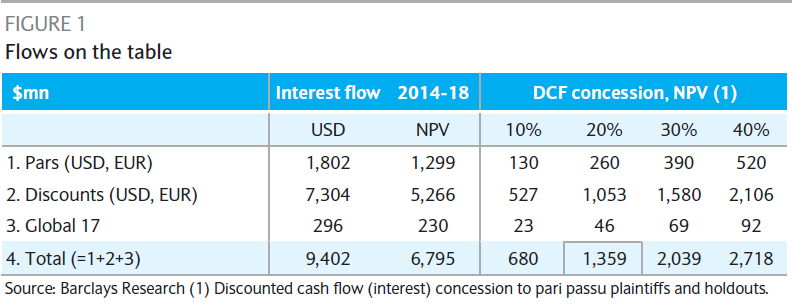
The actual details of the proposal — see the FT’s take on it last week, or the Argentine press a bit earlier — would have restructured holders turf over about 20 per cent of their coupon payments to holdouts, for about half a decade.
You could call this a “discounted cash flow concession”, as Barclays analysts Sebastian Vargas and Donato Guarino do in the chart below.
It sounds nicer than ‘holdout tax’.
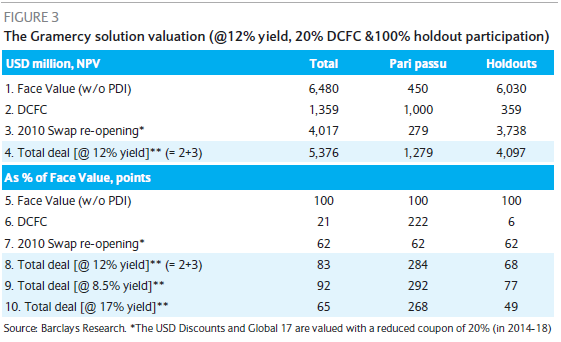
The $1.3bn dollars or so of cash involved (on some strong assumptions of participation and so on) would go on top of what holdouts could get from signing up their bonds to Argentina’s usual restructuring offer. Argentina recently reopened it. Technically the plan doesn’t need Argentine involvement, but it does assume that offer remains available, and Argentina probably needs to sign a release anyway.
The restructured bondholders, for their pains, would at the very least safely get their remaining 80 per cent without it getting injuncted. But this isn’t the main point — that would be to unleash an enormous rally in Argentine bond prices that would overshadow the loss of the coupons, thanks to the government being able to borrow in the US again and generally not have Judge Griesa in its face.
Higher prices overall after the deal might make more holdouts sign up. Exit yields would fall. That’s another chart on this from Barclays above. Note their assumption ofall holdouts signing up: every last Argentine abuela stiffed by her government back in 2001 (they’re not all foreign vulture funds). Although lower prices beforehand might be needed to get enough restructured holders to agree to send over bits of theircoupons. More on this in a bit.
The quality of Gramercy
But oh, oops — first, this is not a plan by restructured bondholders in the plural, just to be clear.
This is Gramercy’s plan. Gramercy Funds Management (“We are Emerging Markets®”) is one of the big players currently litigating tooth and nail against the ratable payment order, as part of the Exchange Bondholders Group.
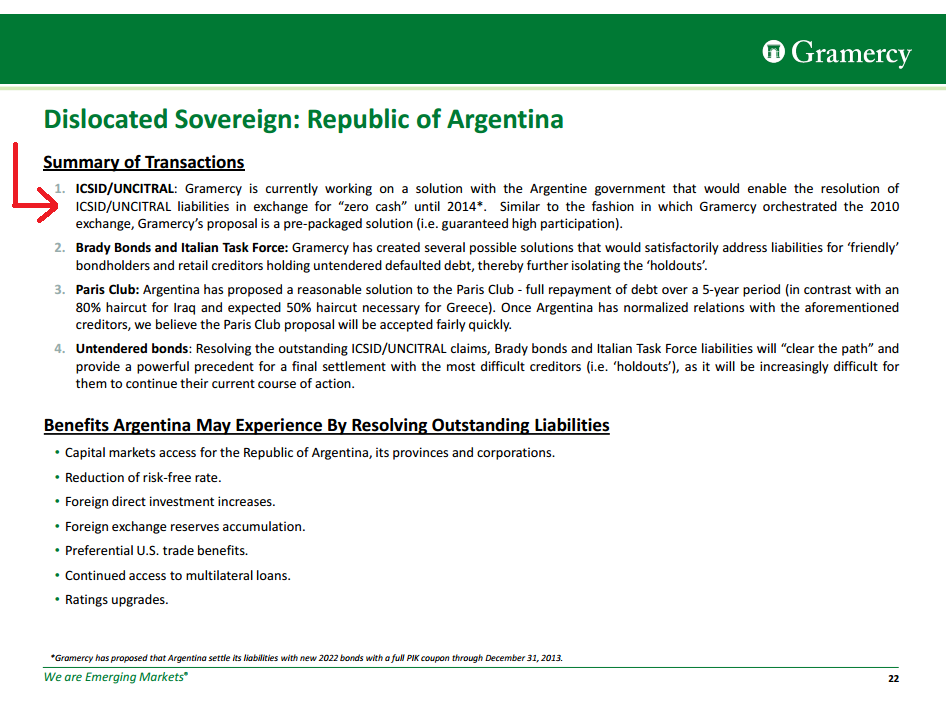
But they also have a very interesting sideline in cutting deals that help out the Argentine government (click to enlarge):
That’s a Gramercy Distressed Opportunity Fund II presentation from September 2012 — predicting, with astonishing clairvoyance, that a solution could be found to Argentina’s contretemps with holders of ICSID awards it also wouldn’t pay.
By October 2013, a solution was found: Argentina paid holders in US dollar local-law bonds (“zero cash…”) settling the claims and getting access to World Bank loans. It is not clear if Gramercy’s “pre-packaged solution… guaranteed high participation” from September 2012 involved buying up some of the ICSID claims itself at a discount — as reported.
There’s much more on Gramercy’s role in this recent Les Echos profile by Isabelle Couet. But needless to say — there’s some complexity here in the origins of this inter-creditor deal.
Not least, other exchange bondholders have other ideas about how to negotiate. One is to wait until Argentina has defaulted on everyone, if or when the US courts have finally gone against it… take the pain which default would cause to restructured bond prices, and only then go talk to the pari passu plaintiffs. In theory, they couldn’t use default as leverage on their side by that point. It’s a bit like Thomas Schelling androcking the boat.
Still, with all that in mind — is the plan actually realistic? We have three points.
1.) The plan needs 85 per cent of exchange bondholders to sign up to it overall. That’s the threshold for activating the aggregate collective action clause contained in the restructured debt’s terms, the one needed to alter “all affected” bonds rather than just one series. Which is why Gramercy has been busy shopping the plan around other investors.
In terms of principle, there might be restructured investors who just refuse to give up their coupons. They’ve restructured once, for a start. But there are particular bonds (say, under English rather than New York) whose holders have consistently argued that the original injunction on Argentina shouldn’t at all apply to payments owed to them. So why cut their coupons now?
In terms of price, though, it might get tricky. There’s already been a fairly big rally in Argentine bonds, because of the ICSID settlement, but also because Kirchnerism seems to be going out of style with a vengeance.
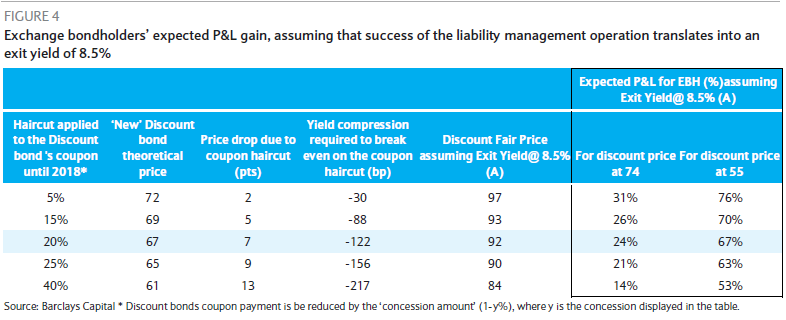
So, there might be quite a few investors who sold into this rally at much higher prices than a month or two ago. The new owners of the bonds, bought as much as 20 points dearer in price, may not like so much the idea of a coupon cut.
Still, money, or capital appreciation, might talk. A third chart from Barclays:
2.) But the plan also needs the highest level of participation from the other side. Holdouts, including pari passu plaintiffs. You could say that’s simple to get — only about three or four funds are currently driving the pari passu litigation. So once they’re won over to a suitably remunerative proposal, a deal should be sewn up. And you could well be wrong.
If you go back to the logic of ratable payment, Harry might be able to sue Tom and Dick, and potentially Tom and Dick can settle with Harry. But maybe Sue can sue Harry too, if Sue has received nothing from the borrower. She could also crank out injunctions against her uniquely recalcitrant borrower whenever it tried to borrow in the US, in the meantime — note the ‘normalisation’ case for Argentina’s benefit from an inter-creditor deal… — but it’s worth contemplating the prospect of some holdouts remaining… holdouts, and suing holdouts who took whatever comes out of Gramercy’s proposal.
That might not be realistic. Not every Argentine holdout can afford Elliott’s legal fees. Still, as Barclays point out, the current proposal implies that the amount of subsidy to each holdout falls the more pari passu plaintiffs who sign up, leaving the remaining holdouts in an interesting position — which is why they’ve run the numbers with a “conservative assumption” of 100 per cent participation.
3.) If the plan goes ahead and it doesn’t work, the sovereign bond market might still get left with it as a precedent. Intercreditor agreements aren’t unusual in corporate debt restructuring. There, you might find some (therefore junior) creditors agreeing to turn over payments they get to other (therefore senior) creditors, if the borrower hasn’t paid the latter fully. But that presupposes the concepts of senior and junior creditors… collateral… and corporate bankruptcy, as the alternative place to fight this stuff out.
Sovereigns don’t go bankrupt. More to the point they’re not supposed to have hierarchies of creditor either… openly. At least not among bondholders. Restructured holders agreeing to remit parts of their coupons might be taken as recognition on their part that you get a special status if you’re a holdout and you can hang around long enough.
So why announce the plan?
Possibly because it just undercuts the pari passu holdouts’ leverage a bit at the moment — they’re still winning in the courts (notwithstanding the stay remaining in place), and have the confidence to tell Argentina itself to come to the table.
But even then the pari passu saga — and with it the frontier of sovereign debt litigation — is getting ever more involved in inter-creditor negotiation…

Ads not by this site

Bondholders lose bid to lift stay in Argentina litigation

Friday, November 1, 2013

Bondholders lose bid to lift stay in Argentina litigation

A US appeals court today said it would leave a freeze in place on an order requiring Argentina to pay $1.33 billion in favor of bondholders suing for repayment in the wake of the country's 2002 default.
The 2nd US Circuit Court of Appeals in New York denied a motion to lift a stay it issued in favor of Argentina pending US Supreme Court review of a ruling for the holdout bondholders in August.
The request to lift the stay was made October 15 by bondholders led by hedge funds NML Capital Ltd, a unit of Elliott Management Corp, and Aurelius Capital Management LP.
The case is one of many lawsuits filed by bondholders in the wake of Argentina's $100 billion sovereign default in 2002.
In two restructurings, creditors holding about 93 percent of Argentina's bonds agreed to swap out their bonds in deals that gave them 25 cents to 29 cents on the dollar.
But bondholders who did not participate in the restructurings, including NML and Aurelius, sued for full payment. The litigation was filed in New York under the terms of the bond documents.
In 2012, US District Judge Thomas Griesa ruled Argentina had violated a clause requiring the equal treatment of creditors. The 2nd Circuit largely upheld that order in a decision that the US Supreme Court recently declined to review.
As part of its October 2012 decision, the 2nd Circuit sent the case back to Griesa to clarify how the injunctions he had issued would function.
Griesa issued a new order last November that required Argentina to pay $1.33 billion into a court-controlled escrow account in favor of the holdout bondholders.
The 2nd Circuit upheld that decision, but stayed its impact pending a second appeal by Argentina to the U.S. Supreme Court.
After the 2nd Circuit's ruling, President Cristina Fernandez pitched a voluntary swap of foreign debt in exchange for bonds governed by local law. But Judge Griesa said last month the proposal would violate an injunction he had issued.
Following Griesa's latest order, NML and Aurelius asked the 2nd Circuit to lift its stay.
A three-judge panel denied that request on Friday. Representatives for NML and Aurelius and a U.S. lawyer for Argentina did not immediately respond to requests for comment.
The case is NML Capital Ltd et al v. Republic of Argentina, 2nd US Circuit Court of Appeals, No. 12-105.

O.k. - D.h. für bspw. die 134810 (endfällig 2026), aktueller Kurs ca. 51, sieht Eure Berechnung mit dem spitzen Bleistift gerechnet aktuell dann so aus?

Zitat Zitat von butzi Beitrag anzeigen
1,2% Zins auf Parbonds vom 31.12.2003 bis 31.03.2009 (5,25 Jahre) plus 2,26% Zins auf Parbonds für 4,5 Jahre bis 30.09.2013 macht 16,47%.
1,2% x 5,25 + 2,26 x 4,5 = 16,47
Bis 2019 bleibt die Verzinsung der Parbonds 2,26% p.a.
Bei den Discounts kommt es so ähnlich heraus, aber etwas komplizierter zu rechnen.
O.k. - D.h. für bspw. die 134810 (endfällig 2026), aktueller Kurs ca. 51, sieht Eure Berechnung mit dem spitzen Bleistift gerechnet aktuell dann so aus?

Registriert seit
08.10.2013
Beiträge
115